
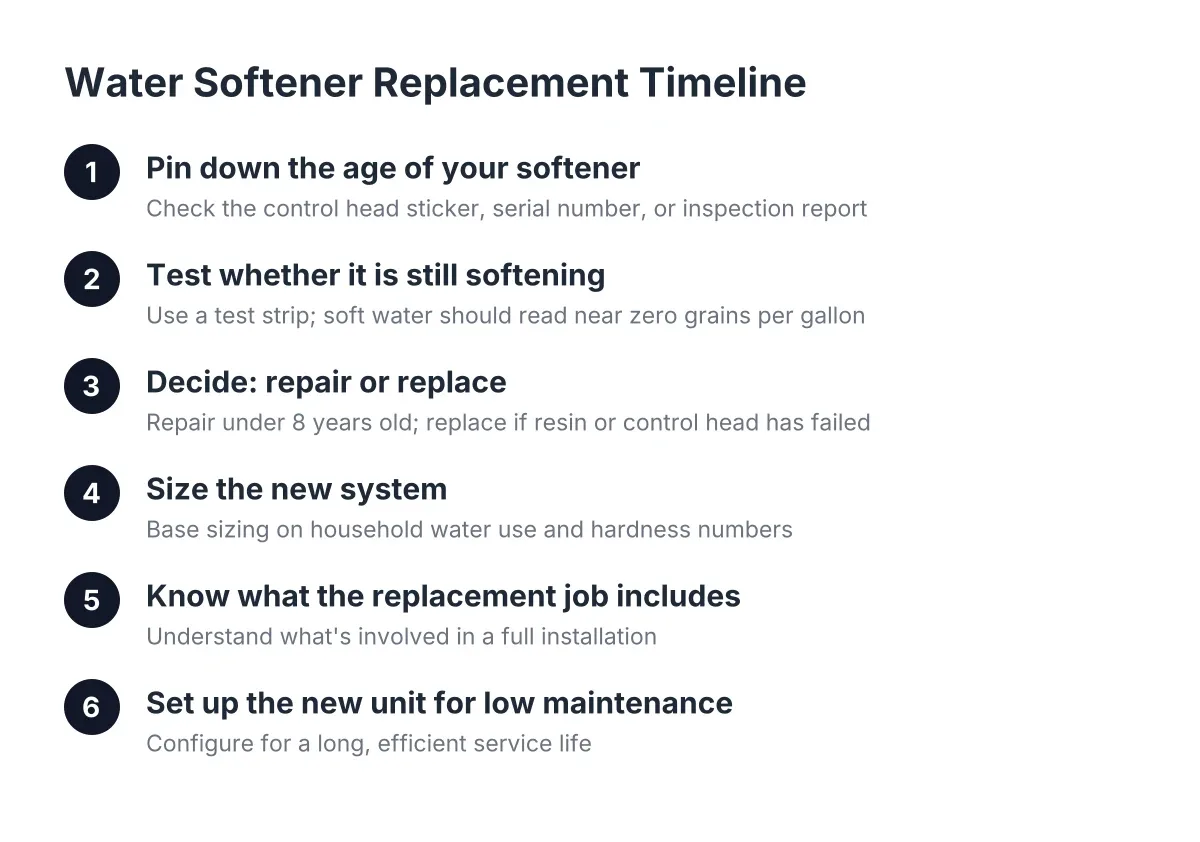
Water Softener Replacement Timeline: When a 10-Year-Old Unit Should Go
Most homeowners find out their water softener died the hard way. The shower door turns white again, the glasses come out of the dishwasher cloudy, and six months later the water heater starts groaning. If your unit is pushing 10 years old, planning a water softner replacement now, on your schedule, beats scrambling after it quits in January. This guide walks you through the decision step by step, built for Minneapolis homes where the water runs hard and many softeners went in decades ago.
Here is the short version. Most softeners last 10 to 15 years. In the Twin Cities, where Mississippi River water pushes hardness to 15+ grains per gallon for Minneapolis-area homes according to HomeWater 101, units work harder and often age faster. A 10-year-old softener is not automatically dead, but it has earned a hard look.
Step 1: Pin Down the Age of Your Current Softener
First, find out what you actually own. If you bought an older Minneapolis or inner-ring suburb home, there is a decent chance the softener in the basement came with the house and nobody knows its birthday.
Look for a sticker or stamped plate on the control head, the valve assembly on top of the tank. Many manufacturers code the production date into the serial number. No luck there? Check the house inspection report from when you bought, or look for an installer's tag with a service date.
Use these rough age brackets to set expectations:
- Under 8 years: Repair usually makes sense if something fails.
- 8 to 12 years: The gray zone. Resin beds often wear out around the eight-year mark, so judge by performance, not just age.
- 12 to 15+ years: Plan the replacement now, even if it still runs. Parts get scarce, efficiency is poor, and failure risk climbs every season.
In addition, note the type. If the unit regenerates on a fixed timer every few days whether you used water or not, it is an older design that wastes salt and water. That alone is a strong reason to replace, which we will get to in Step 4.
Step 2: Test Whether It Is Still Softening at All
Next, check what the softener is actually doing. Age tells you probability; a hardness test tells you fact.
Pick up a cheap test strip kit and test a cold tap inside the house, after the softener. Soft water should test near zero grains per gallon. Minneapolis water enters your home around 15+ grains per gallon, so there is no ambiguity here. If your "softened" water tests at 8, 10, or 15 grains, the unit is passing hard water straight through.
Also check the obvious stuff before you blame the machine:
- Make sure the bypass valve is not switched to bypass. Softeners have dedicated inlet and outlet valves separate from the main house shutoff, according to InspectAPedia, and a bumped bypass lever fools a lot of people.
- Look in the brine tank. Is there salt? Is it bridged into a hard crust with a hollow space underneath? Break up any crust and recheck in a week.
- Confirm the unit regenerates. You should hear it cycle, usually in the middle of the night.
However, here is the key decision rule: if the softener uses salt, cycles correctly, and is not in bypass, yet your water still tests hard, the resin bed inside the tank has likely worn out. On a 10-year-old unit, that is your answer.
Step 3: Decide Between Repair and Full Water Softener Replacement
Now weigh fixing against replacing. This is where most homeowners get stuck, so use the math, not the gut.
Repair makes sense when the unit is under about eight years old and the problem is a single part, such as a stuck bypass valve, a worn seal, or a brine line issue. Those are normal service-call items.
Replacement wins when any of these are true:
- The resin bed is spent on a unit past 10 years. A resin tank service or resin replacement on an old control head often costs a large share of a new system, and you still own an old valve waiting to fail.
- The control head itself is failing. The head is the brain and the most expensive part; replacing it on a dated tank rarely pays.
- It is a timer-based unit. Fixed-schedule regeneration burns salt and water regardless of need. Metered units regenerate based on actual gallons used, and high-efficiency softeners can be programmed to use less salt, water, and energy than standard units, according to Culligan.
- You keep calling for softener repair. Two service calls in two years on an aging unit is the system telling you something.
Suppose a homeowner in a 1962 Richfield rambler has the original-era softener limping along. Say the quote to replace the resin and rebuild the valve comes to roughly half the cost of a new metered system, as an illustrative estimate. In that scenario, replacement is the sound call, because the new unit resets the clock on every component, not just the broken one.
There is also a Minnesota angle worth knowing. The state has pushed hard to cut chloride pollution, since 75% of Minnesotans rely on groundwater that is vulnerable to salt contamination, according to Minnesota Pollution Control Agency. A rebate program in Marshall, Minnesota even paid $500 to $700 to residents who replaced timer-based softeners, per the same agency. Programs vary by city, but the direction is clear: old salt-hungry units are on the way out. Swapping yours is good for your plumbing and your watershed.
Step 4: Size the New System Before You Buy Anything
A replacement is only as good as its sizing. An undersized softener in a hard-water metro lets water pass through too fast to fully soften, especially during high-demand stretches like a Sunday morning with two showers, a dishwasher, and a load of laundry running.
Sizing comes down to three numbers: your water hardness, your household size, and your daily water use. With Minneapolis-area hardness at 15+ grains per gallon, a family of four needs meaningfully more capacity than a retired couple in the same house. In the suburbs on well water, iron and manganese staining adds to the load; ion exchange softeners can reduce small amounts of iron too, according to Penn State Extension, but heavier iron may need a dedicated filter ahead of the softener.
This is also the moment to decide on related equipment. A water softener handles scale buildup and hard water stains. A whole-house filter handles sediment, taste, and odor. They are different jobs, and some homes with older galvanized plumbing benefit from both. One caution: salt-free "conditioners" often disappoint homeowners expecting true soft water, and plenty get swapped out for salt-based softeners later. If your goal is ending scale, a salt-based system is the proven tool.
Step 5: Know What a Water Softener Replacement Job Includes
A proper replacement is more than swapping tanks. When you hire a local installer, the scope should cover:
- Removing and hauling away the old unit, including the brine tank with its years of accumulated salt sludge.
- Inspecting the existing plumbing connections and the drain line, and correcting anything undersized or out of code.
- Setting the new resin tank and brine tank, and connecting a proper bypass valve so the unit can be isolated later without shutting off the house.
- Programming the control head for your measured hardness and household size, with regeneration delayed to overnight hours so it does not wake anyone.
- Loading salt and walking you through the settings.
Expect a straightforward swap to take a few hours in most basements. Older pre-1980 homes sometimes add time if the original plumbing needs adapters or the drain setup was never done right the first time. Costs vary with system size and site conditions, so treat any figure you see online as a rough range and get a written quote for your actual basement.
A capable DIYer can handle a like-for-like swap if the plumbing is modern and the drain is already in place. However, call a pro if you see corroded galvanized pipe, no proper drain connection, an active leak, or signs of water damage around the old unit. Those are not weekend projects, and a bad drain connection can create a cross-contamination risk.
Step 6: Set Up the New Unit for a Long, Low-Maintenance Life
Finally, protect the investment. A modern metered softener asks little of you, but it is not zero.
Plan on refilling salt every two to four months for a typical household, according to Culligan, though hard Minneapolis water and a busy house can shorten that. Keep the brine tank at least a third full and break up any salt bridges. Salt contains insoluble material that settles at the bottom of the brine tank over time, according to Cargill, so plan a cleanout every year or two.
As of 2026, most quality control heads also let you choose between standard sodium chloride and potassium chloride as the regenerant, a switch some Minnesota homeowners make to cut sodium discharge. In addition, sanitize the system after a boil-water order or after it sits unused during a long absence, per Kinetico. A quick professional checkup every couple of years catches worn parts before they become Saturday-night surprises.
The Bottom Line for Minnesota Homeowners
Hard water is not your imagination. The USGS Water Science School data on Minnesota cities shows a median hardness of 9.5 grains per gallon, with 61% of measured cities in the hard or very hard bands, and the Twin Cities metro runs harder still. A softener here does heavy lifting every day, and 10 years of that work takes a toll.
Therefore, treat a 10-year-old unit as a planning trigger, not a crisis. Test your water, run the repair-or-replace math, and schedule the swap in a calm month instead of waiting for the week it dies. When you talk to installers, ask three things: how they will size the system for your measured hardness and household, whether the quote includes haul-away and drain work, and what the metered unit's salt efficiency looks like. A fair quote answers all three in writing.
If you are in Minneapolis or the surrounding suburbs and your softener is showing its age, reach out to Twin Cities Water Softening for an honest assessment and an estimate. Water treatment is the whole focus here, so you will get a straight answer on whether your unit has years left or it is time for the swap.
If you need water softener installation, Twin Cities Water Softening can help.
Related guide: water softener replacement — Complete Guide
Prefer to talk it through? Call +16512171659 — a quick call is usually the fastest way to get a straight answer for your situation.