
7 Signs Your Water Softener Needs Service: Leaks, Low Pressure, Poor Water
Most softener emergencies start small. A drip at the bypass valve, salt that stops going down, a faint white film on the dishes. Catch the signs your water softener needs service early and you fix a $100 problem instead of mopping up a flooded basement floor at midnight. This list walks through the seven warning signs that matter most in Minneapolis homes, what each one usually means, and what to do about it before it turns into an emergency service call.
Hard water here is not a maybe. According to USGS Water Science School, the median hardness across 49 measured Minnesota cities is 162.0 mg/L, or 9.5 grains per gallon, and 61% of those cities land in the hard or very hard range. When a softener quits in this metro, you will see it fast, often within days.
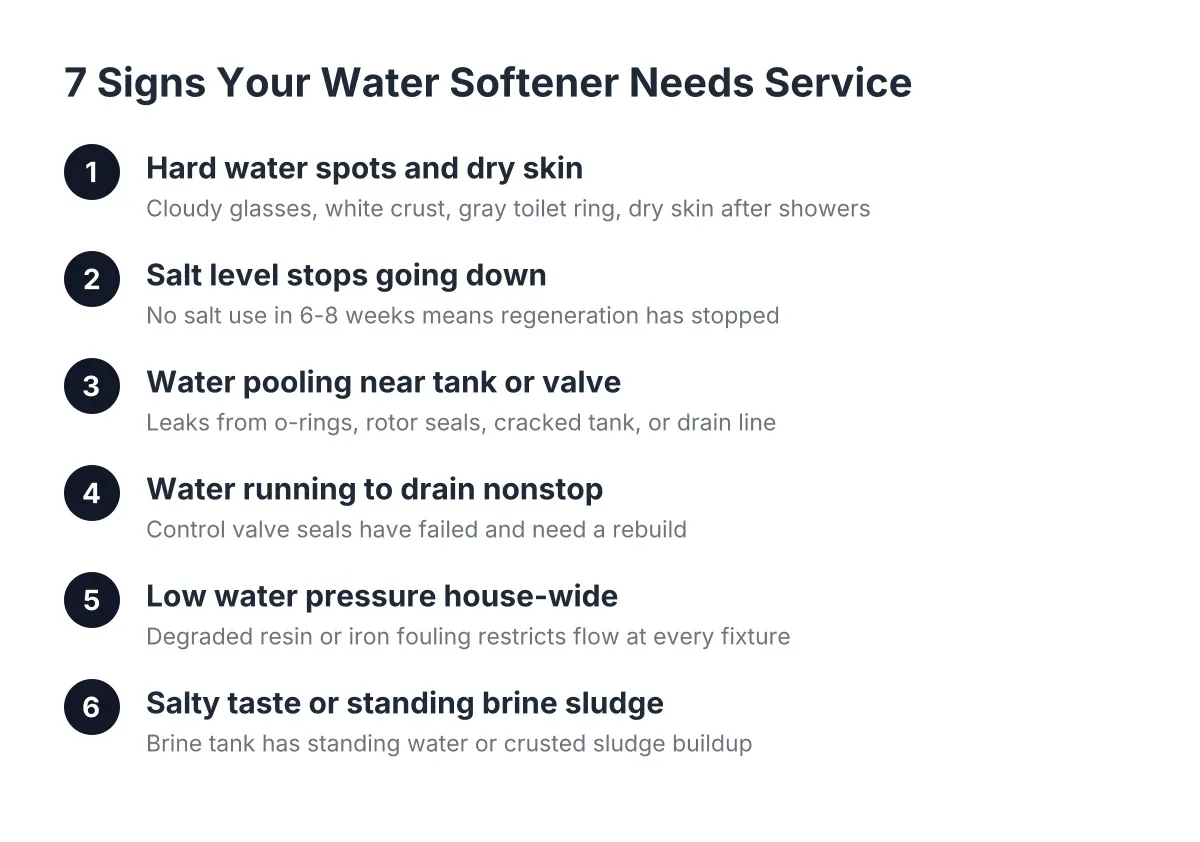
Signs Your Water Softener Needs Service
This is the clearest of all the signs your water softener is not working. If cloudy spots show up on glasses, a white crust forms around faucet tips, or a gray ring appears inside the toilet bowl, hardness minerals are getting past the softener. Soft water does not leave those marks.
Before you assume the unit is dead, check the simple stuff. First, confirm the bypass valve is in the service position, not bypass. A common cause of sudden hard water is a technician or plumber who closed the bypass during other work and forgot to reopen it. Second, check the salt level and look for a salt bridge, a hard crust that holds its shape while the water below runs out of brine.
Your skin will often tell you before the dishes do. Dry, tight skin after a shower and brittle hair are early hard water symptoms, especially if you moved here from a soft-water region and know what your water is supposed to feel like.
2. The Salt Level Stops Going Down
A healthy softener eats salt on a steady rhythm. According to Culligan, a typical household refills the salt every two to four months, though family size, water hardness, and brine tank size all shift that number. If you glance in the tank and the salt has not moved in six or eight weeks, the system has stopped regenerating.
The usual suspects, in order of likelihood:
- A salt bridge, where crusted salt forms a hollow shell above the water line
- Salt mush, a sludge of dissolved salt packed at the bottom of the brine tank
- A clogged brine line or injector that blocks brine draw
- A control valve that has lost its program, often after a power blip
Salt matters because the resin bed cannot clean itself without it. According to North Dakota State University Extension, softeners rely on salt to regenerate the resin that pulls hardness minerals out of your water. No salt draw means no regeneration, and no regeneration means hard water within days.
3. Water Pooling Around the Tank or Bypass Valve
A leaking softener is the sign that turns homeowners into firefighters. Water on the basement floor near the resin tank usually comes from one of a few spots: the bypass valve o-rings, the rotor seals inside the control valve, a cracked brine tank, or a loose drain line connection. None of these fix themselves, and all of them get worse.
Here is the good news. According to InspectAPedia, softeners typically have their own inlet and outlet valves separate from the main house shutoff. Therefore, you can isolate the unit, put it in bypass, and keep running water to the whole house while you sort out the repair. You lose soft water for a few days; you do not lose your basement.
Suppose a homeowner in Richfield notices a slow drip at the bypass and ignores it through a Minnesota winter. The o-rings dry out further, the drip becomes a stream, and by March there is water damage under the laundry room flooring. In that scenario, when a water softener needs service in November, a modest repair call would have cost a fraction of the cleanup. Leaks are the one sign on this list that justifies a same-week call every time.
4. Water Running to the Drain That Never Stops
Walk past your floor drain and hear water trickling, hours after any regeneration should have finished? That is one of the quieter signs your water softener is failing, and it is expensive to ignore. Continuous flow to the drain while the unit sits in service mode usually means the control valve seals have failed and the valve needs a rebuild.
This failure wastes water around the clock and often stops the softener from holding its regeneration cycle. In addition, it can mask itself; the house still gets water, so nothing seems wrong until the water bill arrives or the hard water spots return. A control valve rebuild is a normal repair on a unit under 10 to 12 years old. On an older system, the rebuild cost starts to compete with replacement, and that math is worth running with a local softener specialist before you commit either way.
5. Low Water Pressure Throughout the House
A softener can choke your whole house. Over time, the resin bed breaks down, and in Twin Cities suburbs with iron in the well or municipal supply, iron fouling speeds that up. Degraded resin and iron sludge restrict flow through the tank, and you feel it as weak showers and slow-filling washing machines at every fixture, not just one.
The quick test: put the softener in bypass and check the pressure again. If pressure jumps back to normal, the softener is the bottleneck. If nothing changes, the problem lives elsewhere in your plumbing, and you need a plumber rather than a softener tech. This two-minute check saves you from calling the wrong trade, which is a common worry when water is misbehaving and the clock is running.
Resin does not last forever. Ten to fifteen years is a reasonable life in hard Minnesota water, less where iron runs high. If the resin is bad, a resin tank service or rebed fixes it on a sound unit; on a tired unit, replacement usually wins.
6. Water Tastes Salty, Smells Off, or Looks Discolored
Softened water should taste clean. A salty taste points to a regeneration problem; the unit is not rinsing fully after its brine cycle, often because of a clogged drain line, a failing valve, or a timer set wrong. Orange or brown tint points to iron getting through, which is common in metro suburbs on well water and in some municipal systems too.
A rotten-egg or musty smell deserves attention on its own. According to Kinetico, a softener should be sanitized after a boil-water order, after it sits unused during an extended absence, or whenever taste and odor turn bad, especially on a private well. For a relocator who just closed on a home that sat vacant before the sale, sanitizing the softener belongs on the move-in list next to changing the locks.
7. The Brine Tank Is Full of Standing Water or Crusted Sludge
Lift the brine tank lid once a month. You should see salt, and depending on the model, a modest amount of water low in the tank. However, if the tank holds several inches of standing water above the salt, the brine draw has failed; the unit fills the tank but never pulls the brine back out to regenerate the resin.
Sludge at the bottom is a separate issue with the same fix. According to Cargill, softener salt contains insoluble material that settles at the bottom of the brine tank over time and needs periodic cleanout. Dump, rinse, and refill the tank about once a year, and buy higher-purity salt pellets to slow the buildup. Salt type matters too; according to NSF International, most units can be set for either standard sodium chloride or potassium chloride, but the setting must match the salt you pour in.
How to Confirm the Problem Before You Call
A five-minute hardness test tells you more than an hour of guessing. Hardware stores sell cheap test strips; test the water before and after the softener. Soft water out means the unit works and your symptom lies elsewhere. Hard water out, with hard water in, means the softener is the problem, and the before-and-after numbers tell a technician whether it has stopped softening entirely or is only running out of capacity early.
Then run this short checklist:
- Confirm the bypass valve is set to service, not bypass.
- Check salt level and probe for a salt bridge with a broom handle.
- Verify the control head has power and the time of day is correct.
- Start a manual regeneration and watch for brine draw and a clean rinse.
- Check around the tanks, bypass, and drain line for any moisture.
After any service, run a full regeneration and check for leaks at each stage of the cycle. If anything drips, put the unit back in bypass and fix it before returning it to service.
Know where the line is. Salt bridges, tank cleanouts, and settings are homeowner jobs. Control valve rebuilds, resin replacement, and anything involving a persistent leak call for a professional; opening a pressurized valve body without knowing the sequence can turn a repair into a replacement. If you are searching water softener services near me with a wet floor in front of you, bypass the unit first, then make the call without the panic.
Repair or Replace: Reading the Signs Together
One sign points to a repair. Several signs on an old unit point to replacement. A ten-year-old softener with a leaking valve, degraded resin, and rising salt use rarely earns another rebuild; a five-year-old unit with a stuck bypass almost always does. Age, the number of failing parts, and salt efficiency are the three factors that should drive the decision, not pressure from whoever shows up.
There is also a case for upgrading rather than patching, and it is bigger in Minnesota than most places. According to the Minnesota Pollution Control Agency, 75% of Minnesotans rely on groundwater for drinking water, and chloride from softener discharge contributes to contaminating it. The same agency reports that a rebate and optimization program in Marshall, Minnesota cut salt use by up to 320,000 pounds per year, with some households reducing salt use by as much as 86%, largely by replacing old timer-based units. High-efficiency softeners can be programmed to use less salt, water, and energy than standard units, according to Culligan. As of 2026, demand-initiated units are the default recommendation for any Minneapolis replacement.
Whatever you decide, do not let the system drift back into neglect. Routine water softener maintenance, meaning salt checks monthly, a brine tank cleanout yearly, and a professional service visit every year or two, is what keeps these seven signs from showing up in the first place. The homeowners who fight softener fires are usually the ones who inherited a unit, never looked at it, and found out it existed the day it leaked.
If you need water softener installation, Twin Cities Water Softening can help.
Prefer to talk it through? Call +16512171659 — a quick call is usually the fastest way to get a straight answer for your situation.