
Multi Unit Rental Building Water Softener: Shared System Sizing and Costs
If you own a multi unit rental building in the Minneapolis metro, hard water is not a maybe. It is the baseline. The Twin Cities draws mineral-heavy water from the Mississippi River, and Minneapolis-area homes see hardness of 15 or more grains per gallon, according to HomeWater 101. That level of hardness scales up water heaters, stains fixtures, and shortens the life of every appliance in every unit you own. The question is not whether to soften. It is how to equip a duplex, triplex, or fourplex with one reliable shared system, size it right, and keep service costs predictable while tenants come and go.
This guide walks through that decision the way a landlord actually faces it: one shared softener versus one per unit, how to size for peak demand across multiple households, what the install costs look like, and how to set up maintenance so you are not fielding hard water complaints every lease cycle.
Why Hard Water Hits Rental Buildings Harder Than Single-Family Homes
In your own house, you notice scale buildup early. You see the white crust on the faucet aerator, you hear the water heater rumble, and you fix it. In a rental, you usually find out late. Tenants live with hard water stains for months before they mention them, and by then the damage is already working on your equipment.
Hard water in a rental building costs you in three ways. First, scale buildup inside water heaters forces them to run longer and fail sooner, and in a fourplex that can mean replacing multiple heaters years ahead of schedule. Second, dishwashers, washing machines, and faucet cartridges wear out faster, and you pay for those between tenants, not the renter. Third, hard water stains and spotty glassware show up in move-out photos and unit showings, and they make a clean unit look neglected.
The scale of the problem is regional, not just yours. Across 49 measured Minnesota cities, the median water hardness is 162.0 mg/L, or 9.5 grains per gallon, and 61 percent of cities fall in the hard or very hard bands, according to the USGS Water Science School. Minneapolis sits above that median. Suburbs on well water often add iron and manganese staining on top of the hardness, which means orange streaks in tubs and toilets that no amount of tenant cleaning fixes.
One Shared Softener or One Per Unit in a Multi Unit Rental Building
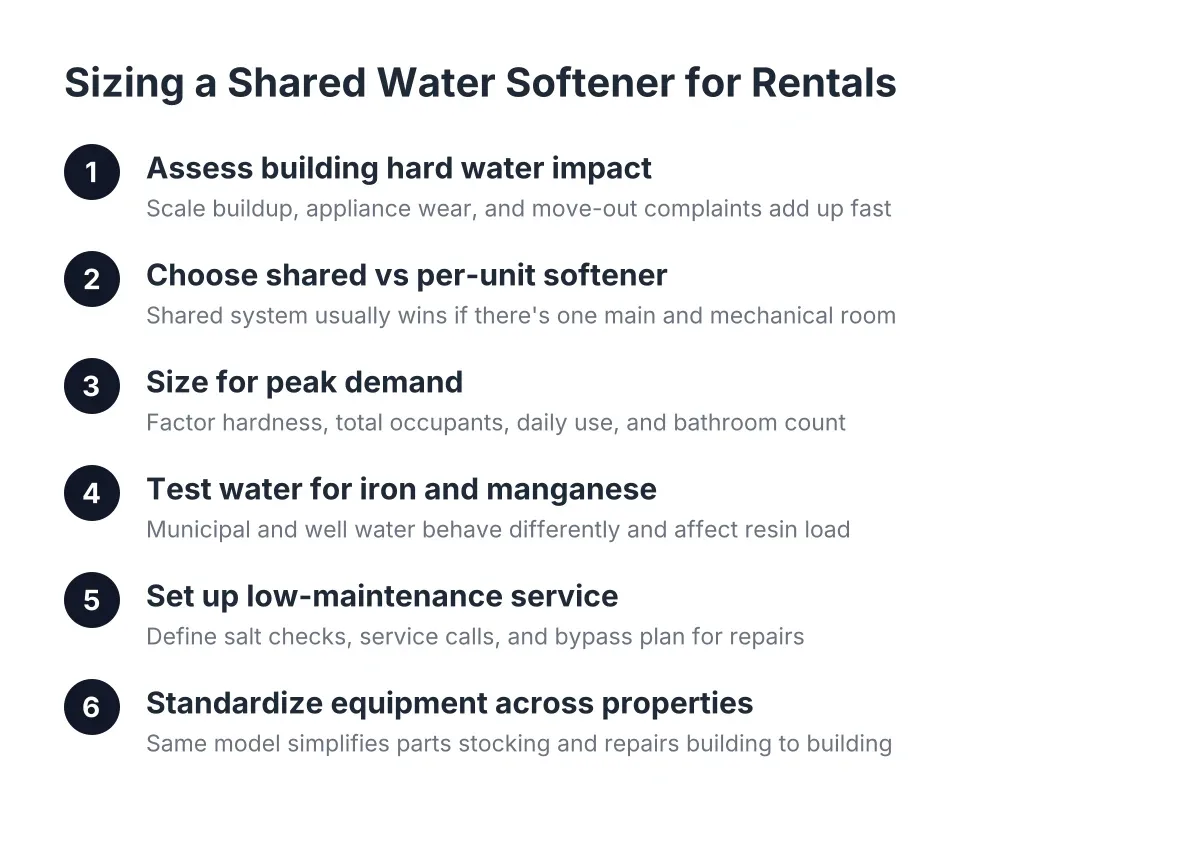
For most small rental buildings in the Twin Cities, one properly sized shared softener beats individual units per apartment. The deciding factor is plumbing layout. If the building has a single water main and a shared mechanical room, one system treats everything downstream: every water heater, every fixture, every unit.
A shared system wins on three landlord priorities:
- Fewer pieces of equipment to fail. One brine tank, one control valve, one resin bed. Four separate softeners means four salt levels to check and four potential leaks in four different units.
- One service relationship. A single service call covers the whole building. You do not coordinate tenant access to four utility closets.
- Lower cost per unit served. One larger softener installed in a mechanical room generally costs less than two to four smaller units, and it takes up space tenants never see.
However, the per-unit approach makes sense in two cases. If the building was converted and each unit has its own water meter, main, and water heater, separate softeners may be the only practical option without re-piping. And if you own scattered single-family rentals rather than one building, each house needs its own system anyway. In that case, standardizing on one model across properties pays off; your service company stocks the right parts, and every repair looks the same.
There is a real trade-off to the shared approach worth naming. With one softener, a failure affects every tenant at once instead of one unit. That is why sizing, equipment quality, and a bypass plan matter more in a multi unit rental building than in a single-family home. A softener with proper inlet and outlet valves can be isolated for service without cutting water to the building, according to InspectAPedia, so tenants keep water flowing even during a repair; it is just hard water until the fix is done.
How Do You Size a Shared Water Softener for Multiple Units?
Sizing a shared softener for a multi unit rental building comes down to three numbers: the water hardness in grains per gallon, the total number of occupants across all units, and daily water use. Multiply hardness by gallons used per day to get grains of hardness the system must remove daily, then pick a capacity that regenerates on an efficient schedule.
Here is the practical math. Suppose you own a fourplex in Northeast Minneapolis with eight total tenants. At 15 grains per gallon and a typical 60 to 75 gallons per person per day, the building uses roughly 480 to 600 gallons daily. That works out to about 7,200 to 9,000 grains of hardness removed every day. In that scenario, a softener in the 64,000 to 80,000 grain range lets the system regenerate every six to eight days instead of every two, which saves salt and extends resin life.
A few sizing rules matter more in rentals than anywhere else:
- Size for peak demand, not average demand. An undersized softener lets water pass through the resin too fast to fully soften during heavy use. In a building with four kitchens and four or more bathrooms running Sunday morning showers at once, peak flow is the real test. Count the total bathrooms across all units, not per unit.
- Test the actual water, including iron and manganese. Municipal Minneapolis water and suburban well water behave differently. Iron loads the resin bed and effectively raises the hardness the system must handle. Ion exchange softeners can help reduce small amounts of iron in well water, according to Penn State Extension, but heavier iron needs a dedicated iron filter ahead of the softener.
- Count occupants honestly, including turnover. Size for full occupancy at your lease maximums, not for the quiet couple in unit two today. The tenants change; the plumbing does not.
- Consider a two-tank configuration for serviceability. A system with a separate resin tank and external brine tank is generally easier to service than an all-in-one cabinet unit, and in a rental building serviceability is the whole game. The trade-off: splitting capacity across two small alternating tanks can reduce peak softening during high demand, so do not shrink the resin volume just to get the twin-tank label.
Bathroom count is a decent first pass, but it is only a rule of thumb. A proper water softener sizing visit measures hardness and iron on site, counts fixtures, and matches capacity to your actual building. For a shared system serving multiple households, that visit is worth insisting on before you accept any quote.
What a Shared System Install Costs for a Small Rental Building
Installed costs for a shared softener in a Twin Cities duplex through fourplex typically land in the range of a large single-family install, often somewhere between the cost of one premium residential system and two mid-grade ones. As an illustrative estimate, many small landlords budget between $1,500 and $3,500 for a correctly sized shared system with professional water softener installation, with the final number driven by capacity, iron filtration, and how much plumbing work the mechanical room needs.
Four factors move the price:
- Capacity. A 64,000 or 80,000 grain system costs more up front than a 32,000 grain unit, but it regenerates less often, uses salt more efficiently, and handles full occupancy without strain.
- Iron and manganese treatment. Suburban buildings on well water often need an iron filter ahead of the softener. That adds equipment cost but protects the resin bed, which is the most expensive part to replace later.
- Plumbing modifications. A clean mechanical room with the main, a drain, and an outlet nearby installs fast. A converted building with odd piping takes longer. A bypass valve should be part of every install so the building can run on hard water during service instead of no water.
- Efficiency features. High-efficiency softeners can be programmed to use less salt, water, and energy than standard units, according to Culligan. In a building where you pay the water bill, demand-initiated regeneration pays for itself. Old timer-based units regenerate on a clock whether anyone used water or not, which is why a Marshall, Minnesota program paid $500 to $700 rebates to replace them, according to the Minnesota Pollution Control Agency.
If you are replacing an aging softener rather than installing fresh, the replace-or-repair math tilts harder toward replacement in a rental than in your own home. A 15-year-old unit limping along in a building you visit twice a month is a tenant complaint waiting to happen. Modern efficient equipment also uses dramatically less salt; the same Marshall program cut salt use by up to 320,000 pounds per year, with some households reducing salt use by as much as 86 percent, according to the Minnesota Pollution Control Agency. That matters in Minnesota, where 75 percent of residents rely on groundwater vulnerable to chloride contamination linked partly to softener discharge, per the same agency.
Low-Maintenance Setup: Salt, Service, and Who Does What
The best softener for a rental is the one nobody has to think about between your scheduled visits. Salt is the main recurring chore. A typical household refills salt every two to four months, according to Culligan, but a shared system serving a full building burns through salt faster, so plan on a monthly check at minimum.
Decide up front who handles salt, and put it in writing. You have three workable models:
- You or your handyman adds salt on a monthly building visit. Most reliable for a shared system in a locked mechanical room, since tenants cannot access it anyway.
- A tenant handles salt in exchange for a small rent credit. Workable in a duplex where the softener sits in a shared basement, risky anywhere the resident might simply forget.
- A service company handles salt delivery and system checks on a schedule. The lowest-hassle option, and the one that scales if you own several buildings.
Beyond salt, build a short annual maintenance routine into your calendar. Softener salt contains insoluble material that settles at the bottom of the brine tank and needs periodic cleanout, according to Cargill. Once a year, have the brine tank cleaned, the hardness setting verified, and the bypass valve exercised so it does not seize. In addition, sanitize the system after a municipal boil-water order or after it sits unused for an extended stretch, according to Kinetico; a vacant unit turnover that stretches a few months is exactly that situation.
One more rental-specific habit: photograph the softener settings and salt level at every unit turnover, the same way you photograph walls and carpet. If a tenant switched the unit to bypass because the regeneration noise bothered them, you want to catch that at move-out, not six months into scale buildup. Note too that most softeners can run on standard sodium chloride or potassium chloride as the regenerant, according to NSF International, so keep the salt type consistent and labeled so whoever refills it does not mix products.
Standardizing Equipment Across Several Rental Properties
If your portfolio is scattered single-family rentals instead of one building, standardization is your version of the shared system. Pick one softener platform, size each install to the specific house, and use the same local service company for all of them. Every rental property water softeners decision gets easier when the equipment, the parts, and the phone number are the same across the portfolio.
The payoff shows up at the worst moments. For example, suppose a tenant in one of your Richfield rentals reports no soft water on a Friday during a showing weekend. If that house runs the same valve and resin tank as your other four properties, your service tech already knows the system, likely has the parts on the truck, and the repair happens in one service call instead of a diagnostic visit plus a parts order.
Standardizing also sharpens your replacement planning. When softeners across your properties are the same age and model, you can budget softener replacement on a rotation instead of reacting to failures. Replace the oldest unit this year during a turnover, the next one the following year, and you never face an emergency install with a tenant in place. Scheduling a water softener install during unit turnover is the single best timing move a landlord can make; the crew works in an empty unit, water can be off without a complaint, and the new tenant moves in with soft water from day one.
A service arrangement with a local water treatment specialist rounds this out. For a small landlord, that usually means scheduled salt and inspection visits, priority scheduling when something fails, and one vendor who knows every system you own. You do not need a managed-services contract built for a 200-unit portfolio; you need a local installer who answers the phone and already has your equipment list.
Handling Tenant Hard Water Complaints the Right Way
Tenant hard water complaints are usually your earliest warning that the softener has a problem. Spotty dishes, dry skin, soap that will not lather, and orange or white stains on fixtures all point to the same thing: hard water is getting through. Treat the complaint as free monitoring, not a nuisance.
Run this quick triage before booking a service call:
- Check the salt. An empty brine tank is the most common cause and the cheapest fix. If the tank has salt but a hard crust has bridged above the water line, break it up; the system cannot make brine through a salt bridge.
- Check the bypass valve. If the softener is in bypass, every drop entering the building is hard. Someone may have bypassed it during unrelated plumbing work and never switched it back.
- Confirm power and the clock. Softeners rely on salt to regenerate the resin bed, which is what removes hardness minerals, according to North Dakota State University Extension. If the control valve lost power or its schedule, regeneration stops and the resin exhausts.
- Test the water. Cheap hardness test strips at each unit's tap tell you in minutes whether the system is actually failing or the tenant is noticing something else, like iron staining that needs separate filtration.
If salt, bypass, and power all check out and the water still tests hard, the problem is likely exhausted or fouled resin, a failing control valve, or an injector clogged with sediment. Those are repair-or-replace conversations, and on a system past 12 to 15 years old in a rental building, replacement usually wins on total cost and tenant goodwill. A professional should also handle anything involving well water with significant iron or manganese, since getting the treatment sequence wrong wastes money on equipment that cannot do the job alone.
Putting the Plan Together
Equipping a multi unit rental building with soft water comes down to a short sequence. Test the actual water at the building, including iron if it is on a well. Size one shared system for full occupancy and peak morning flow, not for today's tenant count. Spend the extra money on a high-efficiency, demand-initiated unit with a serviceable two-tank layout and a proper bypass. Then lock in the maintenance: a named person for salt, an annual brine tank cleanout and settings check, and photos of the system at every turnover.
Do that once, correctly, and the softener disappears into the background of owning the building, which is exactly where you want it. The water heaters last, the fixtures stay clean for showings, and hard water drops off your tenant complaint list for good.
If you need water softener installation, Twin Cities Water Softening can help.
Prefer to talk it through? Call +16512171659 — a quick call is usually the fastest way to get a straight answer for your situation.